





Over the past 5 years at Nina.care, we placed over 3000 au pairs. And yes, we learned a lot. The extended au pair host contract we provide to our host families and au pairs has been checked by legal experts and is fine-tuned over the past years. This contract template is a generic one, but you can find contract downloads for your specific country below in this blog.
Note: It’s not a one-pager! But rightfully so: this setup will help you both to agree on the things we have seen to cause conflicts, and it’s good to lay down the rules of your agreement.
Contract, weekly schedule and house rules
Nina.Care encourages both parties to sign an agreement in which they promise to respect some duties, responsibilities and boundaries together. Nina.care added as part of the contract a weekly schedule and houserules. If you fill in those three documents you are all set for your au apair journey!
Important: this agreement is designed to be adapted to fit the specific local regulations and cultural expectations of each country. Please keep in mind that the agreement documents a cultural exchange arrangement, and does not constitute an employment contract. Also the country’s governmental rules prevail.

Contract checklist What Needs to be Included?
- Duties of the host (such as pocket money, a private room for the au pair, transport allowance etc.)
- Duties of the au pair
- Working hours and weekly schedule
- Pocket money
- Holiday entitlement
- Room description
- Insurance information
- House rules
- Notice period
- Personal agreements (course, transport, etc.)
Note: the au pair should be added to the liability insurance (as a family member) in case she damaged or broke personal property of the host family. For more specific information for each country, you can visit Nina.Care blog for each of the countries we operate in.
Ask your contract questions to our AI chat agent
Contract Requirements by Country: Where are the Contracts Mandatory?
You can check here in which countries the agreement is mandatoryand download the contract. At Nina.Care, we encourage you to sign an au pair host agreement regardless of whether it is compulsory or not to have one in the country.
Downloadable Templates: the Netherlands and Germany
The Netherlands and Germany have a specific agreement which slightly differs from the one of other EU countries. You can download the contracts here.
| Country | Is an Au Pair Contract Mandatory? |
| The Netherlands – based on the Official Au Pair Program Regulations (IND) | Yes, it is mandatory. |
| Germany | Yes, it is mandatory. |
Downloadable Templates: Other EU countries
| Country | Is an Au Pair Contract Mandatory? |
| Belgium | Yes, mandatory |
| Denmark | Yes, mandatory |
| France | Yes mandatory (official “Convention” form) |
| Ireland | No, recommended but not legally required |
| Italy | No, recommended / often required by agencies |
| Norway | Yes , mandatory for visa |
| Spain | Yes, required |
| Sweden | Yes, required |
Downloadable Templates: Non EU countries
| Country | Is an Au Pair Contract Mandatory? |
| Australia | Yes, required for visa (formal au pair / cultural exchange agreement) |
| China | Yes, contract required (agency or host + visa paperwork) |
| New Zealand | Yes, formal employment agreement required |
| Switzerland | Yes, mandatory and registered with local authorities |
| United States | Yes, mandatory through an accredited agency only |
Downloadable Template: the UK
Important: It is fundamental to know that only people who can apply to the Youth Mobility VISA or to the Skilled Worker Visa can legally work as an Au Pair in the United Kingdom. Therefore, the formal work contract is only targeted towards these candidates. You can read more on our blog about Au Pairing in the UK after Brexit and here on the government website.
- The UK (mandatory).
Want to Learn More? Country Blogs:
You can read more information about the regulations per country in the Nina.Care country blogs:
- Australia
- Canada
- China
- Belgium
- Denmark
- France
- Germany
- Greece
- Ireland
- Italy
- Netherlands
- New Zealand
- Norway
- Spain
- Sweden
- Switzerland
- United States
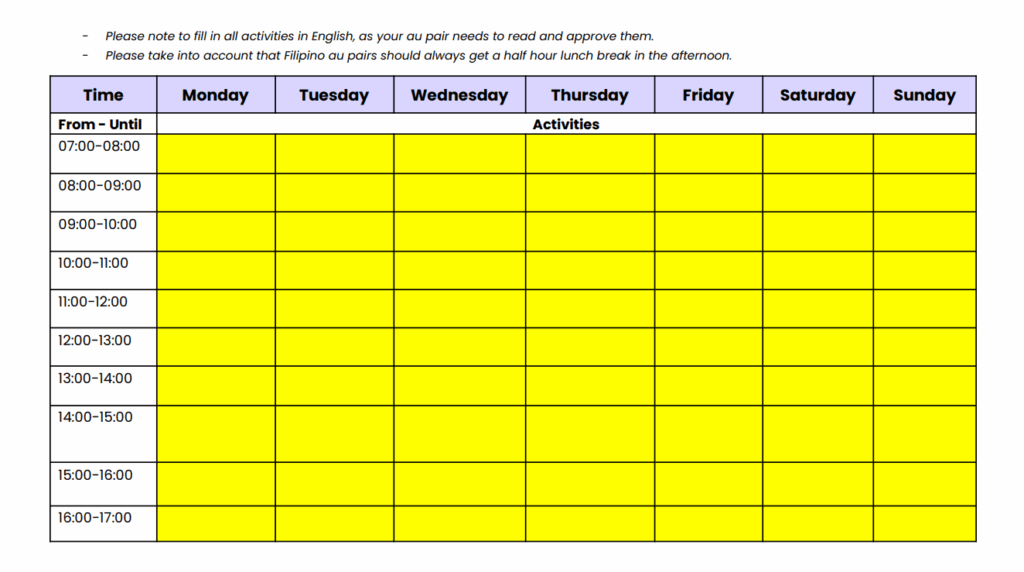
What is a Weekly Schedule, and Why is it Necessary?
Download our template for the au pair and host weekly schedule below
Before starting the cultural exchange, both the family and the au pair are required to sign a weekly schedule. This can be based also on the national regulations for au pairing that vary per country and that can be checked on our blog page. We advise you to be honest about your expectations and think about this a bit longer. Take your time here to make sure you are all aligned when you / your au pair actually arrives.
The family and the au pair choose the schedule together, keeping in mind different factors, such as:
- The right of the au pair to have free day(s) during the week
- The right of the au pair to have holidays time
- The working schedule of the host family
Make sure to both sign the schedule before arrival and we advise to have a weekly check in moment to align on the week and optimise the working together with some feedback.
What are the Au Pair duties? What is she allowed to help with?
The au pair can help with some light household chores. However, she is not supposed to do deep cleaning or any sorts of heavy or dangerous work. Here is a complete list of the chores the au pair is allowed to help with:
List of light house work which is allowed: | The au pair is not allowed to do heavy or dangerous work, as for example: |
| Caring for the basic needs of the children. Taking them to and picking them up from school. Support with laundry (for the children or the entire family). Feeding and walking pets. Watering indoor plants. Support with washing dishes and loading/unloading the dishwasher. Taking out the trash bags. Changing children’s bedding. Vacuuming and mopping floors in shared spaces/childrens rooms. Cooking and/or preparing simple meals and snacks (for the children and/or the entire family). Light grocery shopping. Support with gardening. | Scrubbing floors and deep cleaning. Cleaning bathrooms and toilets, except if the au pair has their own bathroom/toilet. Cleaning out refrigerators, cabinets, drawers. Assisting in house rearrangement or maintenance (drilling, sawing, replacing fuses, moving furniture and kitchen appliances). Any tasks related to cleaning or repairing vehicles (unless the vehicle is used by the au pair for personal use). Making and/or changing the beds of host parents. Washing windows (inside or outside). |
What are the House Rules?
Each family has its own rules regarding the shared resources and spaces (e.g., sharing food, use of common spaces), inviting people over (e.g., if the au pair is allowed to bring friends and/or a partner over) and other issues.

Host families can also decide whether the au pair should have a curfew during the working days, or if she/he is expected to let them know in advance if staying out overnight. These rules are decided to ensure safety and open communication between the family and the au pair.
Other sets of rules might include cultural norms that the household follows and that the au pair is supposed to respect. This might relate to the religious faith or the values that the family considers important and that the au pair should be aware of. At the end of the document, there is a blank space in which such norms can be specified and agreed upon.
At Nina.Care, we encourage the au pair and the host family to agree in advance on the rules and expectations and to find a common ground to guarantee the best experience for both!
Frequently Asked Questions (FAQ)
Is an au pair contract legally binding?
Yes. It outlines rights, duties, hours, pocket money, and living conditions and is legally binding for both host family and au pair.
Can we update the contract during the stay?
Yes. Changes can be made if both parties agree and amendments are put in writing.
Who prepares the contract?
Usually the host family prepares it using the official au pair agreement template (Nina.care can guide and review).
When should the contract be signed?
Before the au pair arrives and before visa/registration steps are completed.
What happens if expectations change?
Discuss openly, adjust duties/hours if needed, and record any changes in writing.
What if there is a conflict or rematch? Try mediation first (Nina.care support can help). If it cannot be resolved, a rematch or early termination can be arranged following contract terms.
If anything is still not clear about how Nina.Care works, please check our FAQ section.